Decoding plant signals
Mycovolt Technologies is an Edinburgh-based agritech startup working on plant electrophysiology, first funded through an opportunity seed in our Abundant Manufacturing opportunity space. Opportunity seeds are smaller awards for speculative and ambitious research, designed to test an early idea and find out whether it holds up.
Where the evidence is persuasive, we can expand the work through a seed boost – and Mycovolt has just received one. We caught up with Mycovolt’s Sam Jellard and Akira Alexander and ARIA Science + Technology Lead Fabrizio Ticchiarelli-Marjot to hear more about their work.
Can you tell us a bit about what you’ve been working on?
Sam: We're tapping into the electrical communication language of plants, so that farmers and growers can rapidly detect crop stress at scale. ARIA first funded us in August 2025, and our main goal has been to capture plant signals in response to stress as clearly and reliably as possible. Day to day, that means developing our hardware and software together to crack the challenge of deciphering the signals we're recording.
Akira: We started with potato plants to look at the bioelectronic signal profile of one of the world's largest food crops. We’ve learned a lot about how the humble potato likes to communicate – and how it sometimes doesn't.
Fabrizio, what does a Science + Technology Lead do, and how did Mycovolt become part of your seed portfolio?
Fabrizio: Central to my role is working closely with our funded teams: getting into the weeds of the science, challenging them constructively, and deciding the most promising direction for a project. The ARIA model allows us to be agile and pivot the strategy based on what we find, and we make full use of that flexibility.
I oversee the delivery of the first seed portfolio in the Abundant Manufacturing opportunity space. One unusual view that I came to ARIA with is that plants are often perceived as passive, waiting for things to happen to them. I no longer think that's a fair representation of what happens: they’re complex organisms that produce a wealth of signals, at a scale that has historically been underestimated. I wanted to see that hypothesis tested, and I couldn't think of a better way than electrophysiology. Mycovolt’s approach could eventually work across a large field, which is the part I find most exciting about funding them.
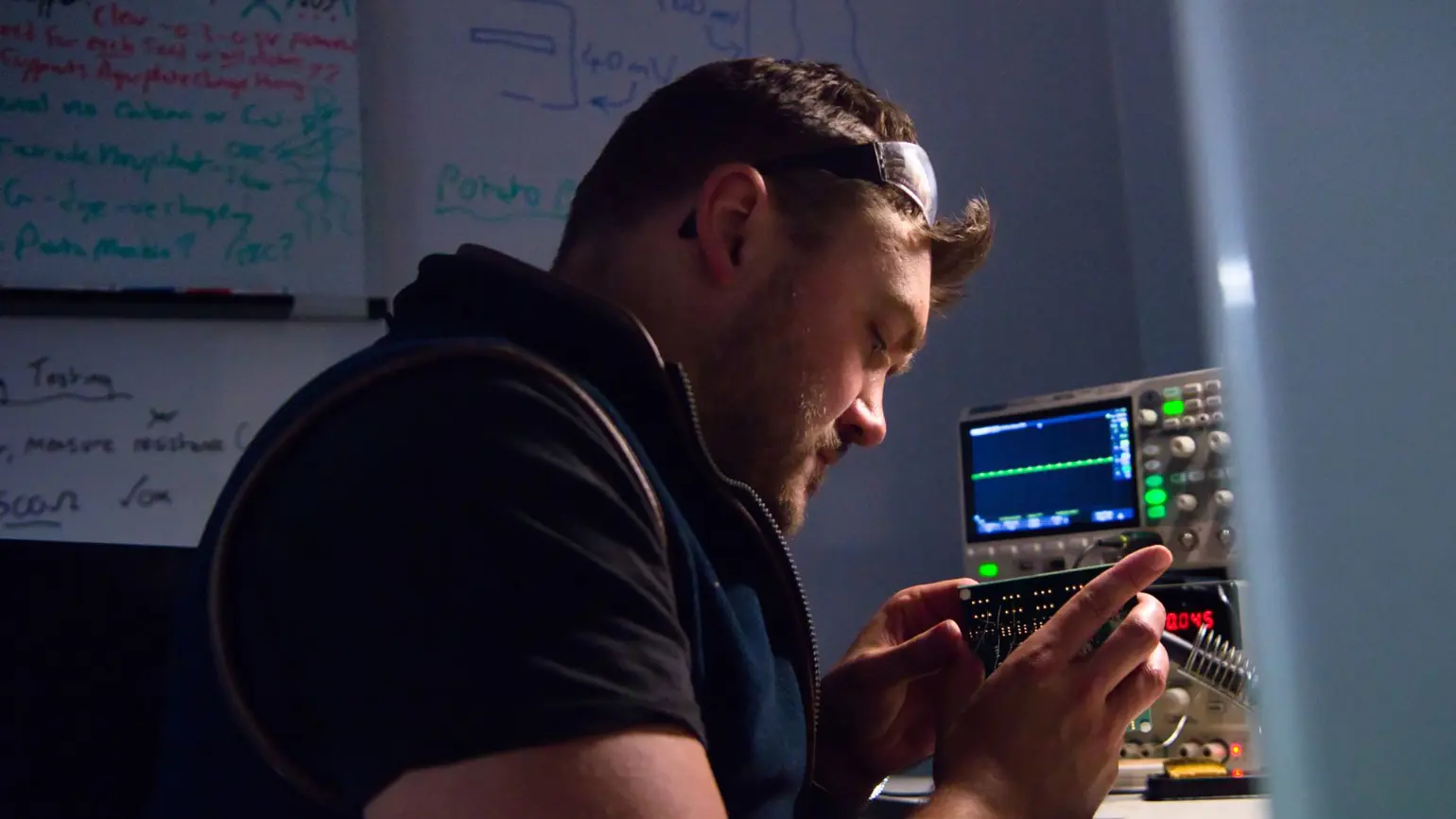
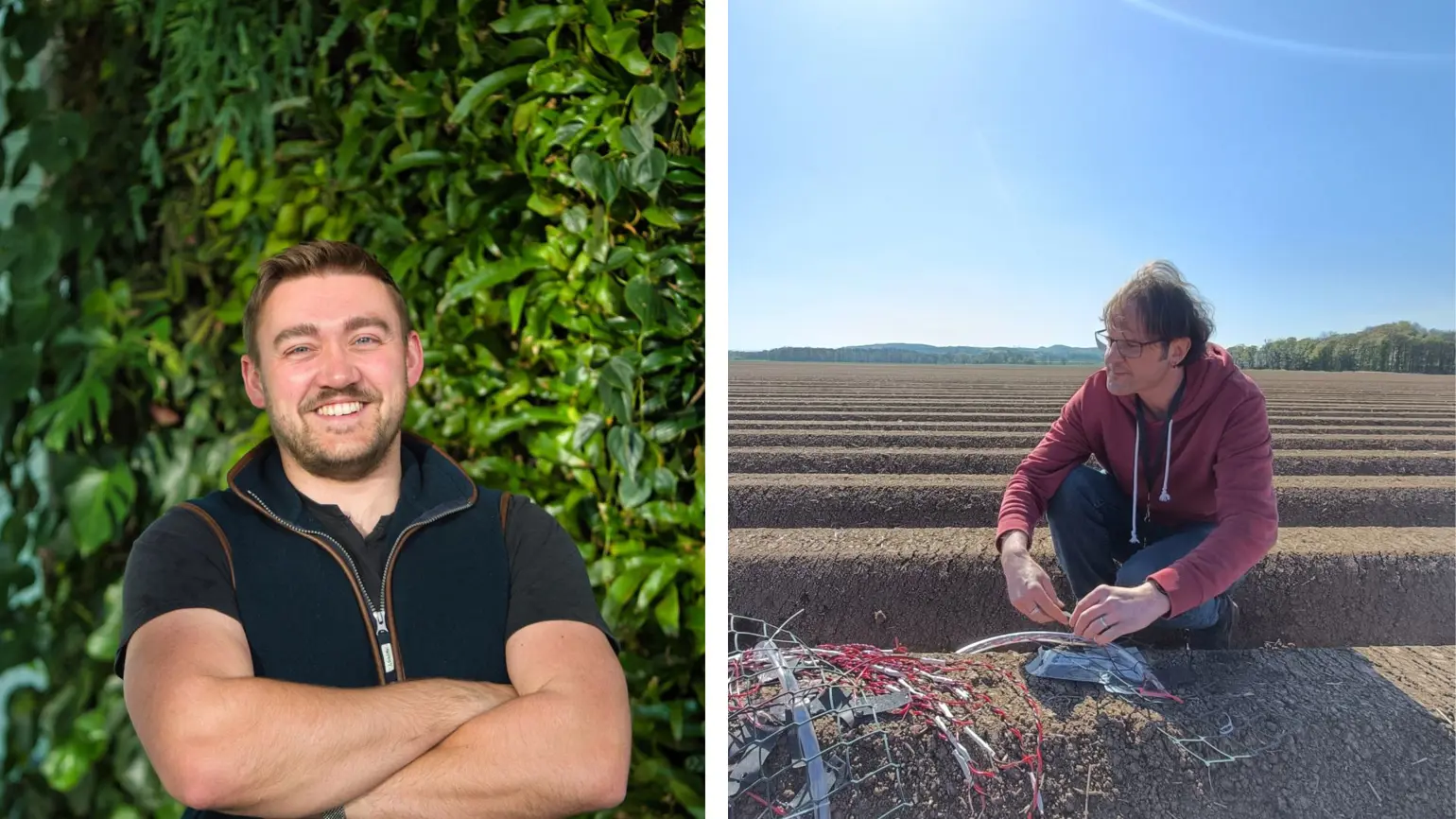
Sam in the Mycovolt lab in Edinburgh.
Most people know plants respond to their environment, but not that they do it electrically. What are these signals, and what can you actually read from them?
Sam: Broadly, what we're observing are nutrient ions that carry an electric charge moving around plant cells in response to change.
Akira: As a biologist, I tend to focus more on the movement of calcium ions. Amongst other nutrients, calcium moving across a cell membrane changes its potential, which impacts the next cell, and the next, in a long chain of events. That's one example of how a plant sends a signal from the top to the bottom.
I was quite sceptical when I started, I won't pretend otherwise. And then I started seeing these signals using Sam's hardware, and it's pretty amazing. A single calcium ion carries a tiny amount of charge, but the coordinated movement of vast numbers of such ions across cell membranes results in observable signals. Plants use this mechanism as one method of communicating with their neighbours, measurably, at quite significant distances. It’s essentially waves of plants speaking to each other.
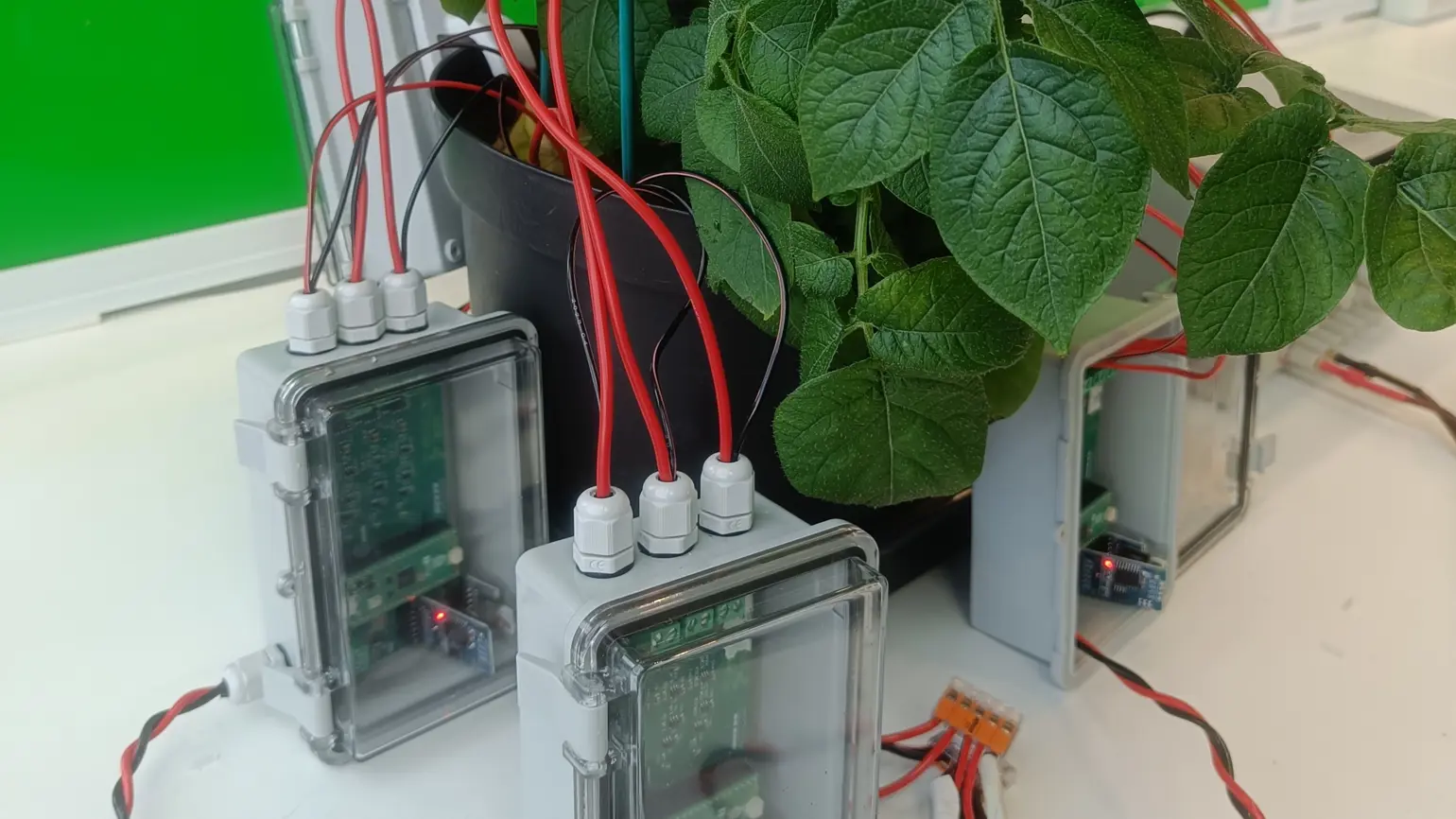
A hardware prototype performance check on test potato plants in Mycovolt’s lab
You recently awarded Mycovolt a £2.3m seed boost. What persuaded you, and what's it for?
Fabrizio: Similarly to Akira, I started with a fair amount of what I'd call optimistic scepticism, which is reflected in this being the smallest of the seeds we awarded in our original portfolio. Having observed the team’s progress, I was struck that these signals could be picked up at all, let alone in an effective way. Mycovolt consistently presented persuasive evidence on their approach, which led us to go for the boost.
To use a slightly cheesy analogy, they were listening to the plants speaking using a new biocompatible material, which was very encouraging for scalability. The team also delivered faster than we’d expected, with outcomes that were significant for the real-world agricultural sector.
The next logical question was: we can read these signals, but can we use machine learning to categorise them? Can we pick them up in much noisier environments? Can we read them at a bigger scale? Can we pinpoint where they're coming from, with enough resolution to be actionable for a farmer? All of that is baked into the vision for the boost. It's designed to create proof points and evidence that others in the ecosystem can build on.
Has something changed in the wider landscape that makes this possible now?
Sam: Definitely. One key factor is how much access we have to good hardware and software development tools, at an extremely competitive price; the combination of both has significantly closed the iteration loop. I'll design a printed circuit board (PCB), we'll run it on a plant for 24 to 48 hours, and Akira will come back and say, for example, that there's a lot of noise in the results — he's crunched a day's worth of data and can see 50 hertz noise across the board. So I add filtering, change the design, and have a new board sitting on my desk ready for testing within a week.
Akira: We're sampling plant signals at least 200 times a second, so there's a huge amount of data to get through. In 2016, I was doing this manually in an Excel spreadsheet. Now, I can build the signal processing framework and know exactly what analysis I want, and carefully-overseen AI tools write the scripts that would otherwise take me days of typing.
What would this look like out in a field, and what could growers do differently because of it?
Sam: We're intending to deploy a large-scale sensing network covering an entire crop, built around two principles: it must not add any burden to growers during their existing work – they’re busy enough! – and must not cause any negative environmental consequences.
Our vision is to provide a data layer that lets growers identify issues with speed and precision across their crop. Currently, a common method of dealing with pests and disease is for a farmer to pre-emptively spray an entire crop with a treatment. Our goal is to facilitate targeted spot applications instead, which would help reduce input costs and chemical spread into our environment.
We aren't aiming to replace farmers in any way. This technology aims to improve how quickly and efficiently they can deal with threats across a crop. Their years of accrued knowledge and experience is what makes this approach possible in the first place.
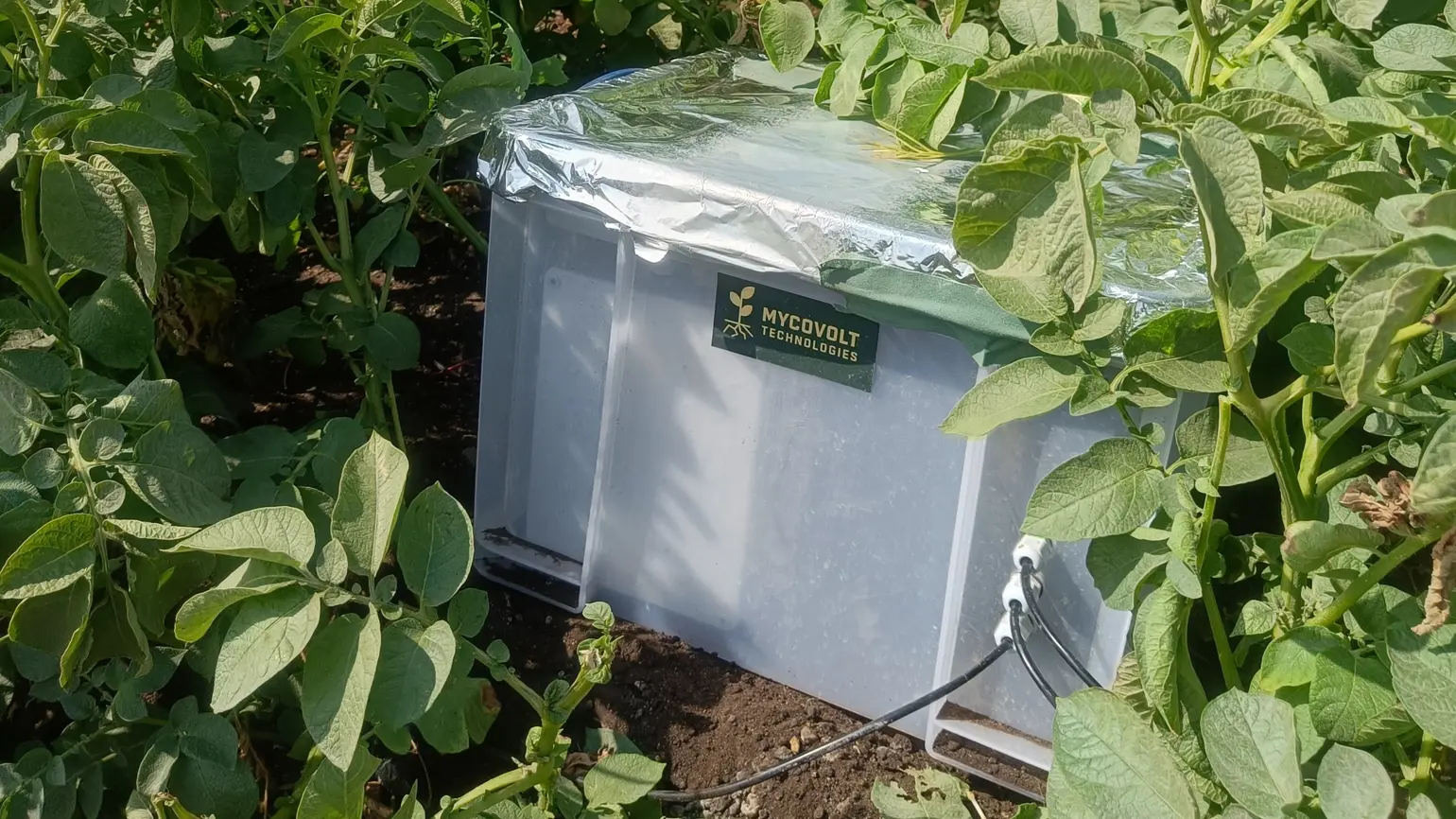
Mycovolt’s hardware out in the field
Thinking about the future, if the technology you’re building is wildly successful, what’s the most ambitious application you could imagine for it?
Sam: We have a lot of blue-sky ambitions for the technology, but the one we'd like to highlight is facilitating plant growth in a low-gravity environment.
Akira: We’re both convinced that electrical signalling could play a significant role in alleviating the impacts of that environment on key processes within plants.
Fabrizio: Mine is much closer to Earth. Today, the industry's focus is overwhelmingly on genetic information in plants. I'd like us to recognise that information in a plant is also governed electrophysiologically, that there's another layer we ought to be thinking about.
Finally, which book, film, or TV show should people check out to understand your work better?
Sam: The Hidden Life of Trees by Peter Wohlleben. It's about communication in a forest, and how it spreads from an individual tree to its neighbours.
Akira: Merlin Sheldrake's Entangled Life. It's an amazing journey into the fungal kingdom and highly worthwhile.
Fabrizio: Those two were the first books I thought of, so I assumed they'd be taken and came prepared with two more options! How to Speak Whale by Tom Mustill is about scientists using technology to understand animal communication. It isn't about plants, but it's very pertinent to interpreting signals we don't quite understand as humans. I also have to recommend Nausicaä of the Valley of the Wind, directed by Hayao Miyazaki in 1984. It's a really imaginative film about nature and our relationship with it, and about using technology to work in harmony with the natural world in a somewhat dystopian setting. There are interesting insights there about how we treat the world, and how we communicate.
Read about Mycovolt here. For photography/image enquiries please contact sam@mycovolt.com.