



Opportunity space
Engineering Ecosystem Resilience
Accelerated Adaptation
Backed by £54m, this programme sits within the Engineering Ecosystem Resilience opportunity space and seeks to explore pathways to accelerate the adaptation of wild species in order to prevent biodiversity loss and secure the natural infrastructure that underpins our global economy and well-being.
Our goal
Today’s environmental pressures outpace nature’s inherent ability to adapt. Climate extremes, land use changes, pathogens, and pollution put one in four species at risk of extinction over the next century, jeopardising the ecosystem functions and biodiversity that underpin our current and future economies.
Improving our ability to measure and model the natural world is vital, but even if we can detect ecosystems at risk of collapse, we lack technological interventions that can support wild species with precision and speed. By leveraging breakthroughs in genomics, robotics, and AI, this programme will explore potential pathways to accelerate the adaptation of species as well as the ethical and governance implications of potential interventions.
These new capabilities would enable wild systems to rapidly overcome threats, ensuring the survival of the vital natural infrastructure that underpins our global economy and well-being.
Technical Areas
This programme is split into five Technical Areas (TAs), each with its own distinct objectives:
Systems
Demonstrate accelerated adaptation in specific systems (species, ecosystems, ecological functions).
Scaling
Scale the technical capabilities of the tools developed by the system-focused teams to apply to multiple systems.
Modelling
Model which species, traits and interventions produce disproportionate ecosystem resilience gains, and quantify risks.
Data + analytics
Ensure that claims made by system-focused teams are independently checked and make results comparable, trusted and legible.
Ethics + social responsibility
This broad TA could include, but is not limited to, co-developing ESR tools, frameworks and guidance; delivering training to project teams; producing evidence that could inform future governance models/regulatory pathways.
Expanding the Conservation Toolkit
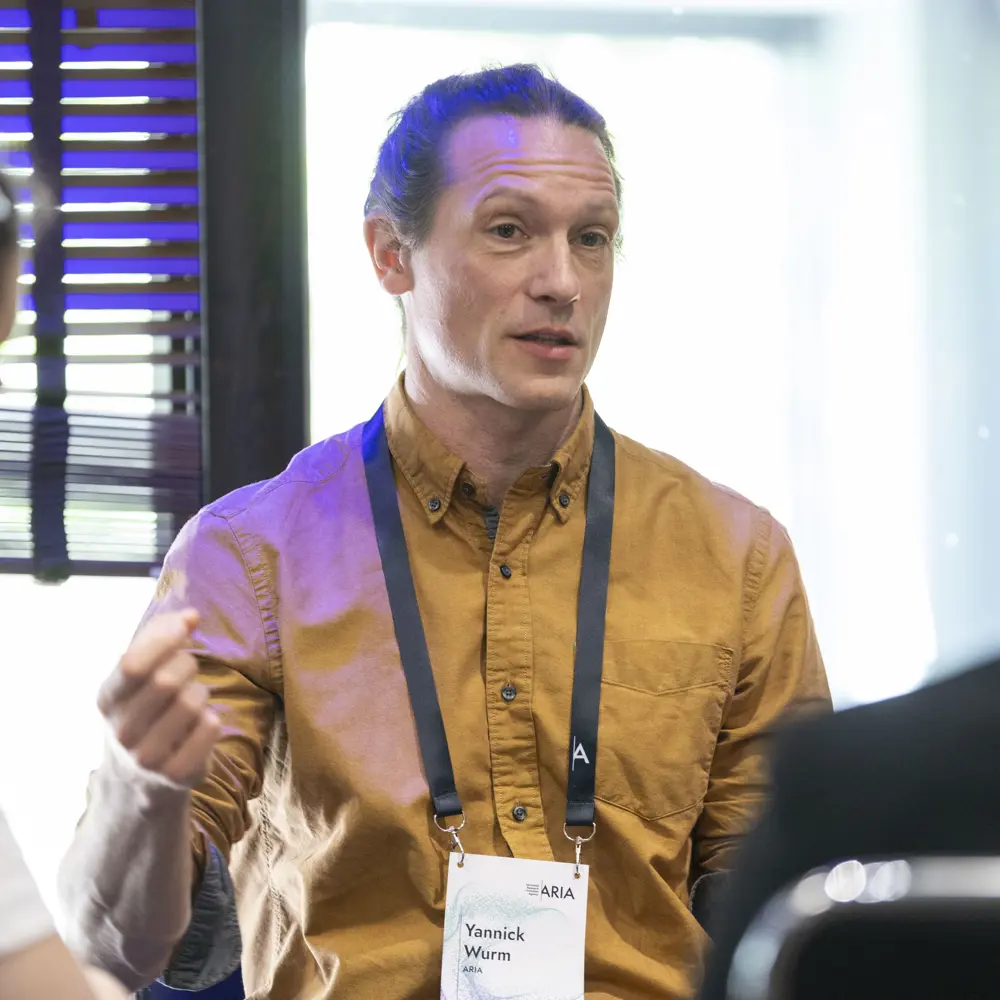
With the launch of the Accelerated Adaptation programme in February, Programme Director Yannick Wurm explains his background and why we’re exploring pathways to accelerate the adaptation of wild species.
Responsible research
We recognise the importance of enabling open and robust consideration of the ethical and social aspects of this programme, as well as ensuring oversight of its funded activities, and seek to do this in a number of ways.
Meet the programme team
Our Programme Directors are supported by a core team that provides a blend of operational coordination and highly specialised technical expertise.

Yannick Wurm
Programme Director
Yannick joins ARIA from Queen Mary University of London, where he is Professor of Evolutionary Genomics & Bioinformatics. Yannick pioneered the use of molecular tools to assess pollinator health, has built startups to commercialise genome analysis software, and created a real-time network for pollinator monitoring.

Alex Smith
Programme Specialist
Alex is a project management professional with experience in complex transformations. He recently streamlined national public service infrastructure for the Nursing and Midwifery Council and has led strategic initiatives at the London School of Economics, including delivering programmes, establishing governance and replacing legacy systems. Alex supports ARIA as an operating partner from Pace.

Simon Evans
Science + Technology Lead
As an evolutionary ecologist with a PhD from Oxford, Simon spent nearly 20 years studying contemporary evolution of wild animals, using long-term studies of nestbox-breeding birds. Before joining ARIA, he studied the evolutionary trade-off between reproduction and survival, showing via experimental selection that this imposes an unbreakable limit to adaptation.

Alice Pettitt
Frontier Specialist
Alice works with the Programme Directors to scope out emerging areas of technology that can shape current and future ARIA programmes. Before ARIA, she was a Venture Fellow at Creator Fund and a Founder's Associate at Gathr. She holds a PhD in Molecular Biophysics from UCL and has also carried out conservation research in the Amazon rainforest.

Programme development
Discover some of the ways we've shaped this programme’s direction.
To help guide our thinking and shape the programme’s development, we funded a series of short, exploratory research projects that ran from November 2025 to January 2026. These projects range from diving into particular research directions and technical feasibilities to exploring ethical and governance needs.
Genetics-based methods for precise interventions against invasive speciesProject lead: Luke Alphey, University of York
This project will analyse the potential use of genetics-based methods for managing/removing invasive species from sensitive ecosystems.
A data-driven protocol to detect and integrate specialist pollinators into landscape restorationProject lead: Nuria Blasco-Lavilla, Independent
This project will develop and test a proof-of-concept protocol to detect specialist pollinator-plant interactions using existing biological datasets and AI-based plant recognition tools.
Understanding resilience for global biodiversity: a text‑mining investigation of national biodiversity strategies and action plansProject lead: Jay Burns, University of Edinburgh
This project will use AI to analyse how countries define and apply “resilience” in their formal biodiversity plans; it aims to identify global patterns, gaps, and priorities to inform more effective and equitable biodiversity policy and ecosystem management, including to guide future research directions.
Universal method for plant cell regenerationProject lead: Jonathan Clarke, John Innes Centre
This project will deploy AI based data mining strategies to develop a universal protocol for plant cell regeneration
Engineering ecosystem resilience through the lens of genomic technologiesProject lead: Jose De Vega, Earlham Institute
This project will explore how advanced genomic approaches, from environmental DNA to synthetic genomes, can be used to better monitor, predict, and actively improve environmental resilience in the face of the rapid decline of biodiversity.
TRACER: Turning Literature into Community-built Ecosystem Resilience (Pilot)Project lead: Manmohan Dev Sharma, University of Exeter
This project will develop a community-curated Text2Trait platform powered by AI-assisted, Human-in-the-loop Actionable Research and Vocabulary Extraction Technology (HARVEST) for turning scientific literature into actionable insights within a queryable knowledge graph.
Foundational AI to forecast ecosystem resilienceProject lead: Lynn Dicks, University of Cambridge
This project will explore the potential for foundational AI techniques to forecast ecosystem resilience under engineering and related management interventions, in ways that are useful for nature conservation.
Ethics and governance framework for engineering ecosystem resilienceProject lead: Michael Gyapong Akrasi, Independent
This project will develop a practical ethics and governance framework to guide the responsible and equitable use of emerging technologies such as AI, synthetic biology, and robotics in efforts to engineer ecosystem resilience.
Do we really need DNA?Project lead: Marcus Hicks, Queen Mary University of London
This project will examine the added value and cost-effectiveness that genomic data brings to monitoring ecosystem resilience, in comparison to traditional ecological measurements.
From sanctuary to system: robotics and AI for measuring and expanding pollinator networksProject lead: Henry Hickson, University of Bristol
This project will conduct a feasibility study on using drones to monitor pollinator networks, aiming to support the creation of pollinator-friendly ecosystems and the recovery of natural pollinator populations
Next generation metacommunity modelling for ecosystem resilienceProject lead: Benjamin Hodgson, University of Leeds
This project will develop a mathematical metacommunity model to enhance our understanding of the mechanisms and strategies which promote ecosystem resilience to environmental change in human-dominated landscapes.
Robotics for invasive species: state-of-the-art mapping and workshop seriesProject lead: George Jackson-Mills, University of Leeds
This project will deliver a focused workshop series that unites leading roboticists and ecologists to explore bold, high-risk, high-reward opportunities for tackling invasive species management with robotics.
Towards multi-modal ecosystem modellingProject lead: Oisin Mac Aodha, University of Edinburgh
This project will advocate for investigating a new generation of computational methods that leverage multi-modal data to provide more granular insights into different ecosystems and the species contained within them.
The role of individual variation in population and ecosystem resilienceProject lead: Daniel Nussey, University of Edinburgh
This project will review how individuals are known to vary in their ability to respond to environmental cues and to resist or recover from environmental challenges in natural populations, and consider how this individual level variation might shape population and ecosystem resilience.
Risk, uncertainty and ecosystem resilienceProject lead: Michael O'Connor, Independent
This project will investigate models of risk and uncertainty across a range of fields, focusing on how they influence the way we (mis)value ecosystems, and looking towards potential applications to the insurance industry.
Addressing nature-related risks to engineer ecosystem resilienceProject lead: Tom Oliver, University of Reading
This project will test and refine a new framework for screening different solutions to the nature crisis; we’ll take a systems approach to assessing risk mitigation and adaptation, as well as identifying potential negative side-effects, trade-offs and co-benefits.
Engineering methane cycling in trees for climate and ecosystem resilienceProject lead: Sunitha Pangala, Imperial College London
This project tests whether tree methane cycling is an engineerable resilience trait and delivers a validated woody-tissue methods kit and a deployable genome-to-trait pipeline, laying the groundwork for future augmentation of methanotrophic communities.
Predicting changes in ecosystem dynamicsProject lead: Nathalie Pettorelli, Institute of Zoology
This project will review attempts to model complex biological systems, and assess (i) their ability to simulate ecosystems that give rise to known emergent properties and obey known ecological principles; (ii) their reliance on metrics that can be easily derived from freely available data; and (iii) their potential to yield AI breakthroughs.
Forecasting biodiversity and ecosystem resilience to inform and assess interventionsProject lead: Erik Postma, University of Exeter
This project will review the forecasting literature and identify the key players in the UK’s forecasting landscape to inform the development of a multidisciplinary ecosystem forecasting framework aimed at developing, monitoring and assessing large-scale ecosystem interventions.
Landscape Engineering for Biodiversity Resilience Applications (LEBRA)Project lead: Axel Rossberg, Queen Mary University of London
This project will provide the theoretical foundation for a new landscape biodiversity engineering tool powered by computationally efficient modelling rooted in first ecological principles.
Socio-technical engineering for ecosystem resilienceProject lead: Lindsay Stringer, University of York
This project will deliver a socially responsible framework for engineering ecosystem resilience, applicable across a range of innovations, integrating diverse knowledge and stakeholder perspectives.
Integrating biodiversity monitoring with metrics of ecosystem resilienceProject lead: Joseph Tobias, Imperial College London
This project will focus on streamlining integration between advanced biodiversity monitoring technologies and predictive ecosystem models and metrics with improved capacity to monitor ecosystem risks and identify appropriate interventions.