
AI in Science
Exploring the possibilities of AI-driven discovery
AI Scientists
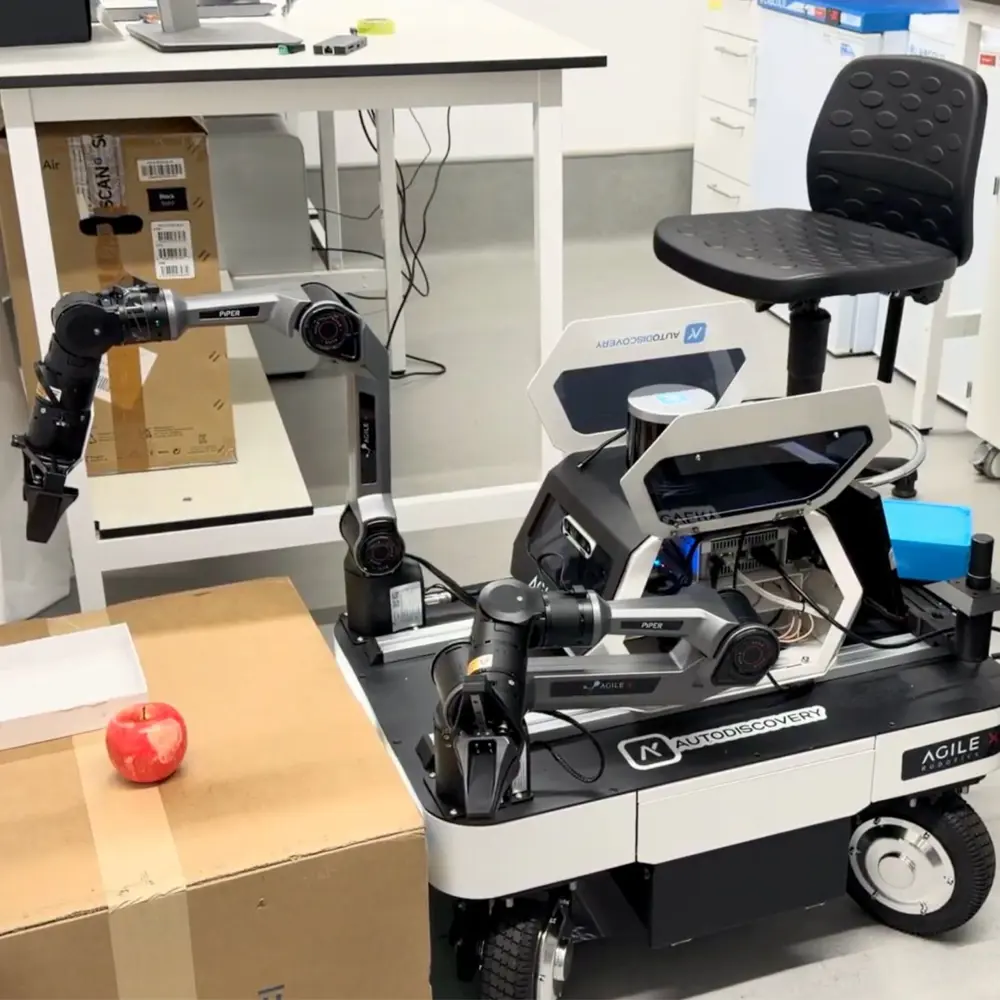
AI is reshaping the scientific landscape. While AI for science has been central to recent scientific progress, emerging capabilities point to an even more foundational shift in scientific discovery: AI Scientists designed to conduct the entire research process without continuous human intervention.
These systems could generate hypotheses, design experiments, run them in automated labs, interpret results, and iterate on findings. If successful, AI Scientists would allow us to explore far more research directions than humans alone – running experiments continuously, spotting non-obvious patterns, and pursuing ideas we might never consider. This could lead to a massive increase in the speed and scale of societally important breakthroughs.
When we issued our call for proposals on AI Scientists – autonomous systems capable of reasoning, planning, and executing experiments – we received 245 applications. It was the largest response to any ARIA call to date, describing work that would have been almost unimaginable just a year ago.
To reflect both the scale of interest and the pace of progress in this emerging field, we have doubled our investment from £3 million to £6 million, supporting 12 projects that span frontier organisations and ambitious new entrants.
Explore the research
Backed by £6 million over 9 months, these projects will test whether AI systems can plan and run scientific experiments in the real world. These projects reflect a striking diversity of technical approaches, from neurosymbolic models to vision-language systems for robotics. Projects span the UK, the US, and Europe, bringing together major platforms, leading universities, and emerging startups.
Together, these teams are tackling a wide range of physical scientific challenges, including:
- Life sciences: autonomously discovering Alzheimer’s therapeutics, improving cancer vaccines, and inventing new genetic regulatory systems.
- Materials science: optimising quantum dot compositions for next-generation displays.
- Energy: uncovering the mechanisms that govern battery longevity.
As AI systems make hypothesis generation increasingly abundant, the bottleneck in science is shifting toward validation: the physical capacity to test ideas in the real world.
These projects are structured as nine-month sprints designed to probe the limits of AI-driven discovery. Can AI Scientists recover when experiments fail? Can they identify interdisciplinary opportunities that human researchers might overlook? To answer these questions, each project will pursue two challenges: one the system is expected to solve, and one where it is likely to struggle.
Amina: Autonomous AI Scientist for Rapid Pathogen Diagnostic Design
Abhi Rajendran, AminoAnalytica
Wet-Lab-First AI Scientist
Katya Putintseva, Briefly Bio
Silico Habilis
Garik Petrosyan, Deep Origin
Automated Elucidation of Mechanisms Driving Age-Related Lysosome Failure
Michaela Hinks, Edison Scientific + Mathieu Bourdenx, University College London
AI-Driven Cell-Free Energy Development and Optimisation
Scott Riggs, Find What Matters + Anton Jackson-Smith, b.next
ThetaWorld
Otter Quarks
Towards a Self-Reflective AI Scientist for Autonomous Sustainable Microbial Protein Biomanufacturing
Miao Guo, King’s College London
Putting a (Better) Brain in the Mobile Robotic Scientist
Andrew I. Cooper + Gabriella Pizzuto, University of Liverpool
The Cancer AI Scientist Project
Lennard YW Lee, Gareth Bloomfield + Anthony Hsieh, University of Oxford
MIND-MATTER: AI-Driven Discovery of Self-Learning Materials
Andrey Ustyuzhanin, Constructor Knowledge Labs
AI NanoScientist
Rafa Gómez-Bombarelli + Milad Abolhasani, Lila Sciences
Hermes: A Self-Improving AI Scientist to Discover and Refine DNA Delivery
Henry Lee, Cultivarium
Funding opportunities
Learn more about how we fund and explore our current and past funding opportunities.
About ARIA
From climate change to AI, society faces challenges that can be uniquely addressed by science + technology.