


Universal Fabricators
Backed by £50m, this programme sits within the Abundant Manufacturing opportunity space and aims to develop scalable processes that use proteins as the manufacturing tools to assemble advanced inorganic and composite materials.
Meet the R&D Creators
We're funding 11 interdisciplinary teams to develop scalable manufacturing processes that use proteins to assemble advanced inorganic and composite materials. The work is organised around three engineering challenges. Each is named for the geometry of the material being built (1D fibres, 2D membranes, and 3D magnets), and each is paired with a product industry needs but cannot currently mass-produce. The challenges are proving grounds for the programme's central bet: that proteins can act as a 'universal fabricator'.
The teams are taking deliberately different routes. Some design new proteins from scratch. Others reprogramme proteins from nature — silk, the surface coats of bacteria, the glass-building proteins of sea sponges. Others start from proteins that are cheap and abundant, often as waste: casein from milk, keratin from wool, proteins from eggs. Depending on the project, the proteins may end up as part of the finished material, or serve as its scaffolds and templates.
Select to explore more:
1D challenge: Fibres
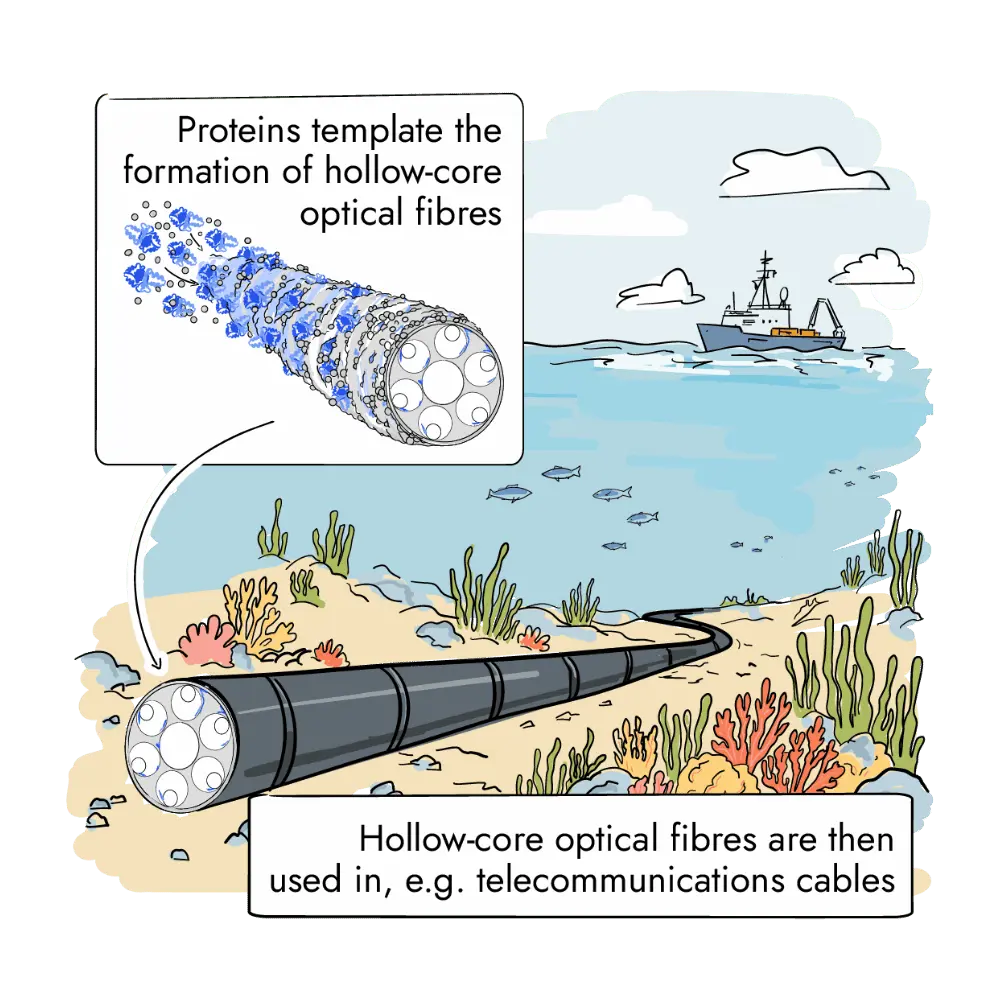
We’ve funded four teams within this challenge to use proteins to grow hollow-core optical fibres, of the kind used in telecommunications, interconnects, lasing, and sensing cables, with shapes and features that conventional fibre-drawing processes cannot produce.
CoreShell Fibre Foundry: reusable protein moulds for growing hollow-core optical fibres
Tell Tuttle, University of Strathclyde
GENESIS: Sea Sponge inspired fibre manufacturing
Meng Zhang, Northumbria University
Glass Noodle: spinning milk proteins into hollow core optical fibres
Tim McGee, Impossible Fibers
HollowSilk: engineering silk proteins for hollow-core optical fibres
William Wadsworth, University of Bath